


A Short History
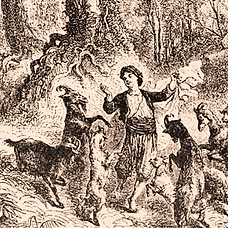

Kaldi and his dancing goats
Gabriel de Clieu sailing to Martinique
The most famous of all coffee legends dates as far back as 5th-6th century AD. Kaldi, a goat herder, living in what is now modern-day Ethiopia, found his goats dancing with glee under a tree of red berries. Having determined the reason for the goats' excitement to have been the fruit in the tree, he picked some and gave them to a tired looking monk passing by from a local monastery. After drying, boiling the berries, and drinking the beverage made by the fruit, the monk found himself rejuvenated with energy. News of the innovation quickly spread to other monks in the realm who made use of the drink in an effort to stay energized through long hours of evening prayer (Davids 11).
Botanical evidence points to coffee originating in central Ethiopia where it is still grown today. It is estimated that the spread of coffee began sometime around 525AD following the Ethiopian invasion of Yemen, where it has been successfully cultivated ever since. Coffee became an integral part of religious ceremonies and quickly spread throughout Arabia. Between 1470-1500, these practices reached Mecca and Medina. Soon, people became so fond of the beverage that it became a secular drink, and in the 1530s the first recorded coffee houses appeared in Damascus and Aleppo, modern-day Syria (Ukers Chapter 3).
Later in the 16th century, colonists and visitors were drawn to the beverage and the drink slowly began to spread across the European continent. In 1714, Louis XIV of France, an avid coffee drinker, negotiated for a coffee tree to be sent to his botanical garden in Paris. In 1723, French naval officer, Mathieu Gabriel de Clieu, was assigned to transplant one of the coffee plant's seedlings in the new world. Legend tells that the seedling had to survive treacherous storms, a pirate attack, and a lack of freshwater before the ship arrived in Martinique. The seedling was credited with the spread of over 18 million coffee trees within the next 50 years, and to be the parent of most all coffee that eventually spread through the Caribbean, South and Central America (The History of Coffee).

What is Coffee


Ripe coffee cherries
Dried coffee, ready for roasting!
While coffee is typically thought of as being dark-colored beans, coffee beans are not technically “beans.” One coffee bean is actually one of two seeds from the inside of a fruit, called a coffee cherry. Coffee cherries are picked from lush, bush-like, trees which are often grown in rows and under the shade of taller crops. After picking ripe berries, seeds need to be separated from their outer layer. This activity is known as coffee processing. Processing typically happens in one of two ways, washed and natural processing.
Washed processing occurs in water tanks where the coffee is typically fermented for 18-24 hours, breaking down the outer layers of the cherry before being washed away with fresh water. Seeds are then left to dry on raised beds or cement patios. Natural processing occurs when ripe cherries are immediately laid out on a patio or on raised beds with fruit intact. After drying, the outer layers are stripped away from the seeds in depulping machines (Davids, 207).
By the time that coffee has been processed and is ready to be sent across the world to roasters, the coffee is green in color and has a grass-like aroma. Jack's job as a roaster is then to guide the green coffee to brown as it rotates above a constant flame and as its moisture content declines. Coffee undergoes various chemical reactions, such as caramelization, to obtain different flavors and aromas. The roasting process of a high-quality coffee can produce more than 800 flavor and aroma compounds. In reference, most fine wines rarely have more than 250 flavor and aroma compounds (Shelton).
Sources
-
Davids, Kenneth. Coffee: a Guide to Buying, Brewing, and Enjoying. St. Martin's Griffin, 2001.
-
The History of Coffee. (n.d.). National Coffee Association (NCA). Retrieved from http://www.ncausa.org/about-coffee/history-of-coffee.
-
Shelton, C. “Coffee Science: What Affects The Flavour of Coffee?” Perfect Daily Grind, 23 Dec. 2019, perfectdailygrind.com/2016/05/coffee-science-what-affects-the-flavour-of-coffee/.
-
Ukers, William. “All About Coffee.” Ukers All About Coffee, 27 Jan. 2011. Retrieved from ukersallaboutcoffee.wordpress.com/all-about-coffee/.